
How to lose weight with bad knees (without making them worse)
Short answer: to lose weight with bad knees, move in ways that don't pound them (water exercise, cycling, strength work), change what you eat in small steady ways, and track fat and muscle, not just the scale. Food does most of the work for weight. Exercise keeps your knees, muscles and mood in better shape. You need both.
4.9 on Google Maps
Why weight matters for your knees
It's a frustrating loop: your knees hurt, so you move less, so weight creeps up, so your knees hurt more. This guide is about breaking that loop gently.
A 2005 study of 142 overweight adults with knee arthritis measured the forces inside the knee as people walked.[1]
Over thousands of steps a day, that adds up. One honest note: the study showed less load on the knee. It didn't prove that weight loss slows arthritis down.[1]
A larger trial, the IDEA study from 2013, followed 454 overweight adults with knee arthritis for 18 months.[2] It compared diet alone, exercise alone, and diet plus exercise:
- Exercise alone: people lost about 2% of their body weight on average.
- Diet plus exercise: people lost about 11% on average, and had the biggest improvements in knee pain and daily function.
The lesson: exercise alone rarely moves the scale much. Combine it with sensible eating and the results are better for both weight and knees.
Low-impact cardio for bad knees: your options
“Low-impact” means at least one foot stays on the ground, or your weight is supported, so there's no jumping or pounding. The US CDC lists walking, cycling, swimming and water exercise as joint-friendly activities for people with arthritis.[3] It suggests building up to about 150 minutes of moderate activity a week, plus muscle-strengthening on two days.[3] You can start with 5 minutes.
Here are the main options, with honest pros and cons.
Swimming
Good: water holds your weight, works the whole body, cheap at a public pool.
Less good: you need to swim confidently, and breaststroke kick bothers some knees.
Walking or jogging in water
Good: easy to learn, water supports you, you can do it in the shallow end.
Less good: hard to make it really tiring, so it may take longer to build fitness.
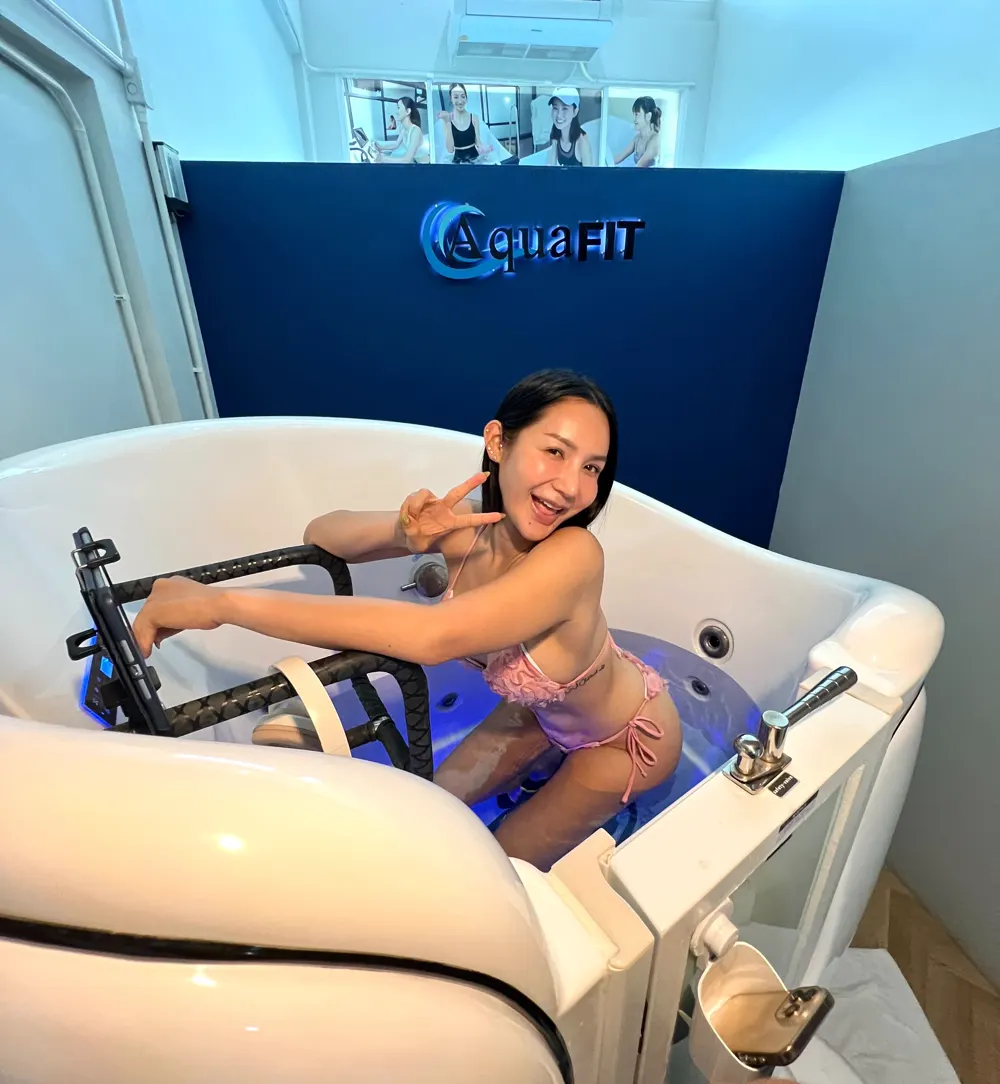
Aqua cycling
Good: water supports part of your weight, there's no impact, and water pushes back on every pedal stroke, so your legs work harder than on a land bike at the same pace.
Less good: you need a pool class or a private tub.
Stationary bike on land
Good: cheap, easy at home. A recumbent bike (the kind with a backrest) is kind to sore backs.
Less good: no water support. Set the seat so your knee stays slightly bent at the bottom of each stroke; too low can hurt.
Walking on land
Good: free, and you can do it anywhere.
Less good: it often hurts. Try several short walks on flat ground, in good shoes.
Strength work
Good: stronger thigh and hip muscles help support the knee. More muscle also helps your body use energy. Simple moves like standing up from a high chair, or straight-leg raises, can be done at home.
Less good: it's easy to do it wrong. Ask a physio to show you a few safe moves first.
Effort varies a lot. As a rough guide, 30 minutes of aqua cycling uses about 130–350 kcal, depending on how hard you go and your body size.
The best exercise is the one you'll keep doing. Pick something you don't dread, and plan when you'll do it each week.
Food basics, in plain words
No fad diets. No cutting out whole food groups. Just steady changes you can keep:
- Fill half your plate with vegetables. They fill you up for very few calories.
- Have some protein at every meal: eggs, fish, chicken, tofu, beans. Protein keeps you full and helps you keep muscle while you lose fat.
- Watch the rice and noodles. You don't have to quit them. Just take a little less.
- Drink water, not sugar. Sweet drinks add up quickly. In Thailand, ask for “wan noi” (less sweet) on your iced coffee or Thai tea.
- Go easy on alcohol. It adds calories and tends to make you snack.
- Don't skip meals and then feast. Regular meals make it easier to eat sensibly.
- Slow and steady wins. Crash diets often cost you muscle, and the weight tends to come back.
If you have diabetes, kidney problems or take regular medicines, ask your doctor before you change how you eat. Some medicines need adjusting when your diet changes. Weight-loss medicines exist too; whether they're right for you is a decision for you and your doctor.
How to track progress (not just the scale)
The bathroom scale only tells you your total weight. It can't tell fat from muscle or water. When you start exercising, you may build some muscle while you lose fat, so the scale can look stuck even when things are going well.
Better ways to track:
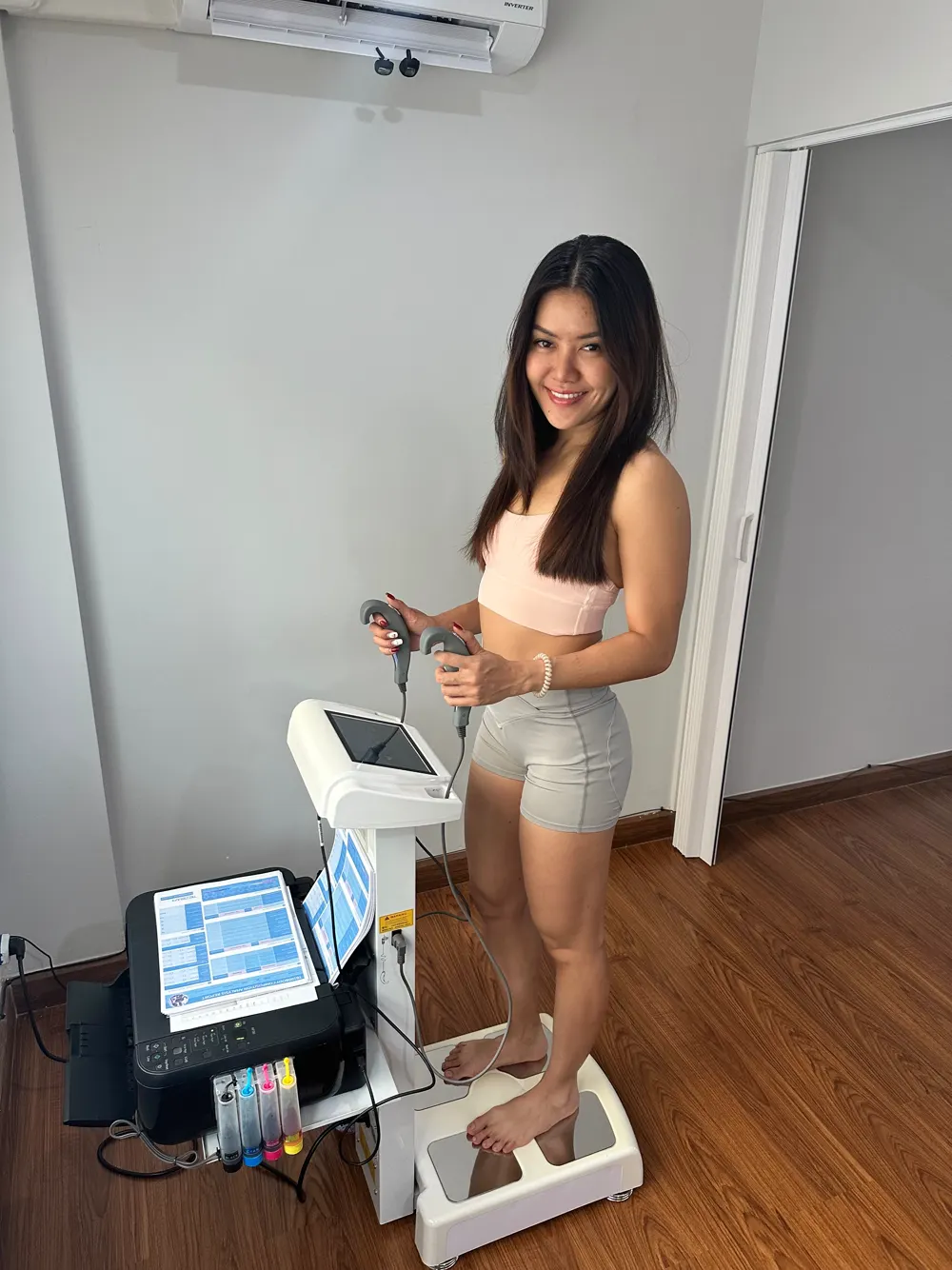
- A body composition scan. This estimates your body fat, muscle and water. The numbers are estimates, not exact. A 2019 study found this type of scanner tracks changes over time well.[5] So watch the trend, not one reading. Scan under the same conditions each time: before exercise, not straight after a big meal or a sauna.
- A tape measure. Measure your waist at the same spot every two weeks or so.
- How your knees feel. Can you climb stairs more easily? Walk further? Get up from the sofa without pushing off?
If belly fat is the worry, your scan also estimates visceral fat – see what your visceral fat number means.
When to see a doctor
Where AquaFIT fits in
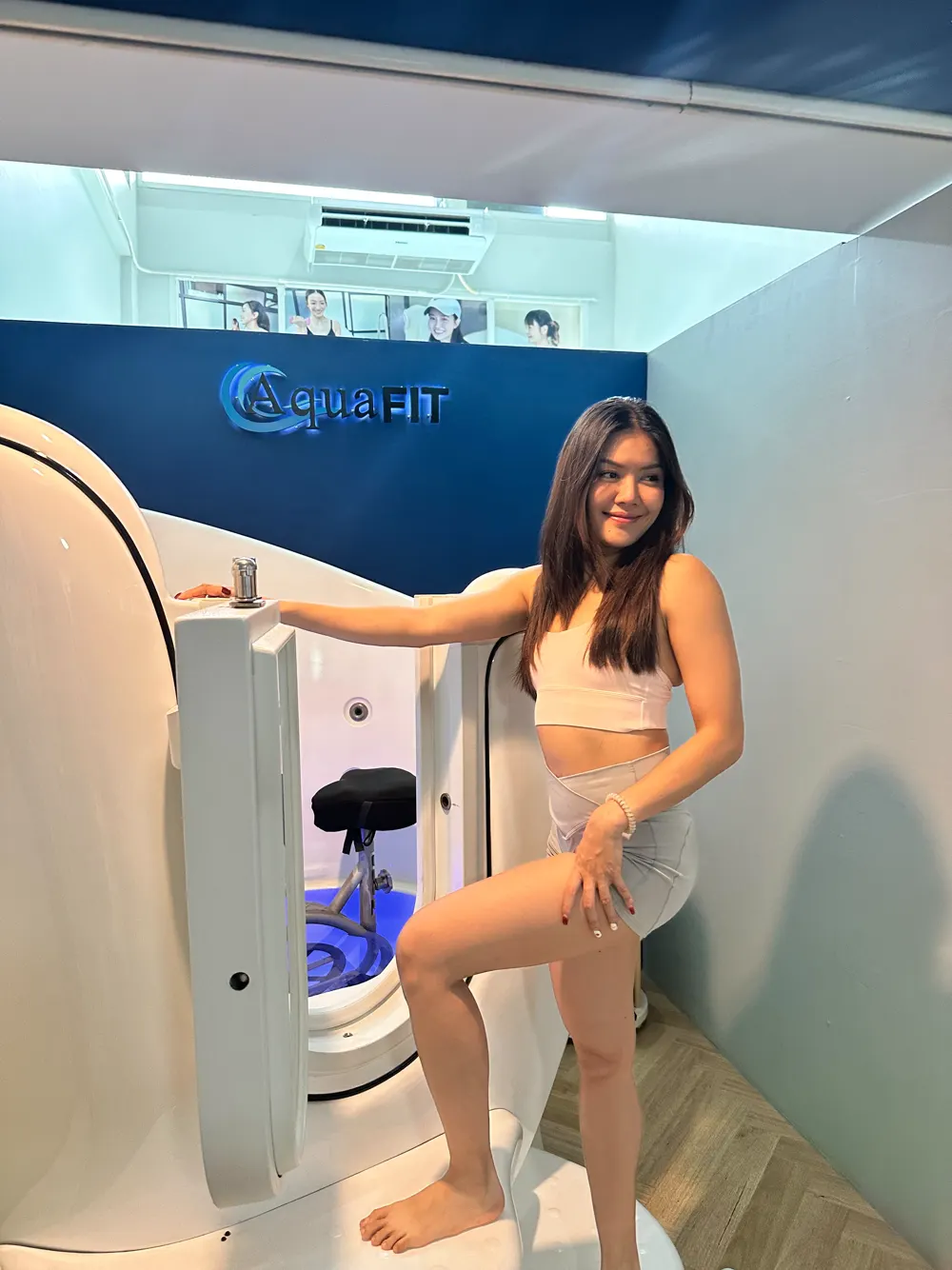
If you live in Chiang Mai, AquaFIT Spabike Center is one option. We offer private aqua cycling in a warm-water tub: one person, your own tub of fresh water (drained and refilled after every customer), massage jets, and a coach to guide you. Your first visit starts with a body composition scan so you can track fat and muscle over time. See our prices and packages.
Our coaches guide you and track your progress on the scan. Weight loss comes from regular exercise, sensible eating and tracking, and we help with all three. See our weight loss programme in Chiang Mai. If your knees are the main worry, see our page on low-impact exercise for knee and back pain. Over 60? See our exercise for seniors programme.
What riders say
“Perfect for those starting to lose weight.
You can come and exercise every day because it's pain-free and doesn't cause any soreness.
After 30 minutes of cycling, they offer a steam room to help reduce muscle soreness.
The staff are very helpful and attentive.”
“I was very impressed with the service from all the staff. Cycling in the water was so much fun! It was tiring, but it didn't affect my knees at all. The place was clean, the service was good and friendly. I highly recommend it!”
“I really enjoyed exercising here. It made me want to exercise every day. The place is clean, parking is convenient, and most importantly, all the staff took good care of me. I really liked it.”
Questions
Anything else? Message us on LINE – we reply in Thai or English.
What's the best exercise to lose weight with bad knees?
There isn't one best. Swimming, water walking, aqua cycling, a stationary bike and strength work are all low-impact. Pick the one you enjoy and can do regularly, and combine it with sensible eating.
Can I lose weight just by exercising?
Some, but usually not much. In a large 2013 study, exercise alone led to about 2% weight loss.[2] Exercise plus diet changes worked much better.
How much weight do I need to lose to help my knees?
Every bit counts. A 2005 study found each 1 kg lost took about 4 kg of load off the knee with every step.[1]
Is walking bad for bad knees?
Not usually, but long walks on hard ground can hurt. Try shorter walks and add water exercise or cycling. If walking keeps hurting, ask your doctor or physio.
Should I use a body composition scan or just a scale?
Both are useful. A body composition scan also estimates fat and muscle, which tells you more. Use the same conditions each time and watch the trend.
Sources
- Messier S.P. et al. (2005). Weight loss reduces knee-joint loads in overweight and obese older adults with knee osteoarthritis. Arthritis & Rheumatism.
- Messier S.P. et al. (2013). Effects of intensive diet and exercise on knee joint loads, inflammation, and clinical outcomes among overweight and obese adults with knee osteoarthritis (IDEA trial). JAMA.
- About Physical Activity and Arthritis. US Centers for Disease Control and Prevention.
- Rewald S. et al. (2020). Aquatic Cycling Improves Knee Pain and Physical Functioning in Patients With Knee Osteoarthritis: A Randomized Controlled Trial. Archives of Physical Medicine and Rehabilitation.
- Antonio J. et al. (2019). Comparison of Dual-Energy X-ray Absorptiometry (DXA) Versus a Multi-Frequency Bioelectrical Impedance (InBody 770) Device for Body Composition Assessment after a 4-Week Hypoenergetic Diet. Journal of Functional Morphology and Kinesiology.